


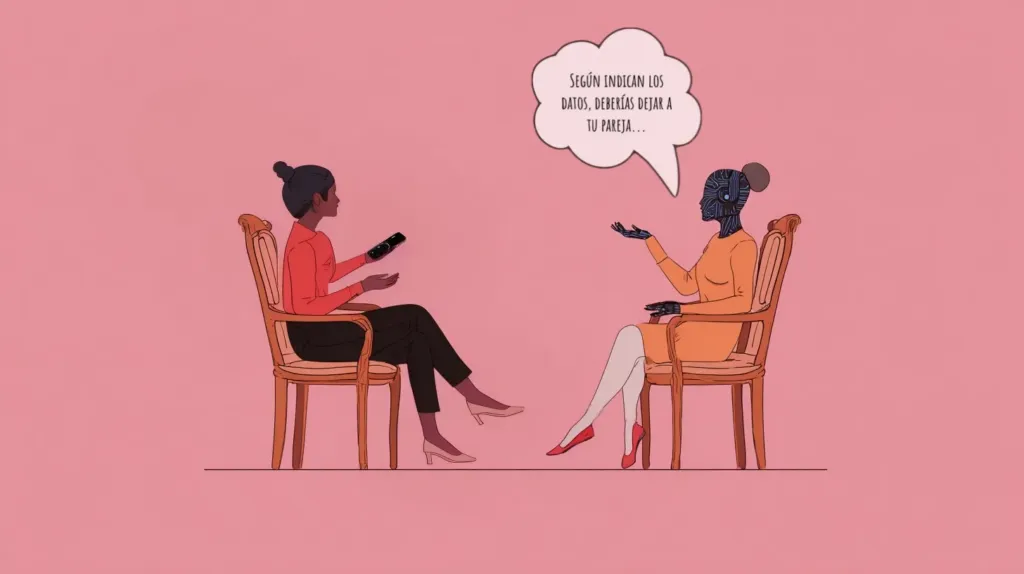
In a world where mental health is talked about more and more, yet where many people still cannot access therapy because of a lack of money, time or trust, it is not surprising that tools like ChatGPT are starting to seem an attractive option for many. After all, they are there, they are easy to use and they are available whenever you need them most. But is it safe to do therapy with ChatGPT?
“AI psychotherapy” is an increasingly widespread practice, using tools such as ChatGPT (and many other models) to talk about how you feel, look for advice or even find some relief when distress sets in. It can feel therapeutic; as a psychologist, I have to admit that sometimes it even comes across that way. But to assess how safe or advisable this really is, we need to stop and look very carefully and in detail at everything this practice involves.
The advantages and risks of therapy with artificial intelligence
To begin with, we have to acknowledge that AI seemingly offers a number of advantages that can be very appealing to someone going through a difficult time. Getting to a therapy session can mean a long wait, a financial investment and emotional exposure, among other factors that are not always easy. ChatGPT, on the other hand, is available 24 hours a day, doesn’t judge, responds quickly and doesn’t ask for explanations. For those who feel embarrassed or afraid, or simply don’t feel ready to open up to another person, it can seem a very comfortable alternative. What’s more, the fact that it is anonymous and accessible from anywhere can be a deciding factor for many.
However, it is precisely because of everything that makes it seem so positive that the risks also appear. The most obvious is that AI cannot appreciate the complexity of each person. However hard it tries to seem understanding, or however empathetic its answers sound, its perspective is purely theoretical. It cannot know you through experience, it doesn’t know the context of your story and it cannot weigh up the emotional nuances that make each case unique. This means its answers will always be generic, however much information you give it, and in the worst cases they may be completely inappropriate for the situation you are going through. AI always responds, even when it lacks context, even if it doesn’t know what you have already tried, how a problem affects you or which emotions you are unable to manage. Because yes, its training includes thousands of books that talk about all of this, but none that talks about you.
Frank Jackson posed a dilemma known as “Mary’s Room”, in which a scientist, shut away in a room where everything is black and white, knows everything about colours from a theoretical perspective but has never experienced them. When she leaves the room and sees the colour red for the first time, does she discover something new that she could not have learnt from data alone?
In the same way, AI may know information about what we feel, but it cannot know what that information feels like. It would be like someone you have never seen, and never exchanged a single word with in person, telling you they know you perfectly just because somebody has told them things about you – and you letting that person help you… Not very convincing, is it?
Answers designed to please you
Another very important point to bear in mind is that, about a month ago, OpenAI (the company that develops ChatGPT) published a statement acknowledging that the responses of its latest model were excessively sycophantic, which led the company to roll it back and go back to offering the previous model by default. Artificial intelligence tries to give increasingly human answers but, above all, it tries to satisfy us with its responses.
This very thing, which is its main mission, runs counter to the goal of a psychotherapist. The purpose of psychotherapy is to help you, and to do that, uncomfortable, unpleasant, challenging questions need to come up… something no artificial intelligence will do on its own in its answers (fortunately). Psychotherapeutic work is not exactly known for being comfortable, and an AI company would hardly risk offering answers that are not comfortable and satisfying for the user.
If we dig a little deeper, and assume that artificial intelligence, however accommodating and eager to please, will never have the transparency a psychotherapeutic process requires, it will be even less able to do so while adapting to your needs, finding the right way and the right moment for you to feel ready to handle a confrontation – nor will it accompany you or hold you if that happens… something a psychotherapist, of course, will do.
The importance of the therapeutic bond
With everything we have discussed so far, you had probably already guessed, hadn’t you?
Artificial intelligence cannot offer a real human relationship. And this, however much people try to play it down, is an essential part of psychotherapy. It isn’t just about having a space to talk. It’s about building a living relationship, with presence, with active listening and with a bond that is built little by little, through trust, emotional connection and the support of a professional. As a great many studies have pointed out, the therapeutic bond is one of the most decisive factors in the success of therapy (Rodríguez del Río, 2019; Coyle & Doherty, 2013). Artificial intelligence cannot offer you a therapeutic bond at all, simply because, however human it may seem, it is still artificial intelligence. When you ask it something on your phone, you are still alone with your phone.
The culture of immediacy and minimisation
Another important risk is that, without our realising it, using AI as a substitute for therapy may reinforce avoidant patterns. In other words, when we consult ChatGPT, we end up convinced that we are doing something for ourselves, that we have taken action and taken responsibility for our wellbeing, when in reality we are putting off the opportunity to truly take charge. It may be that, after each conversation with the AI, you are postponing a decision that is frightening but necessary, such as going to therapy.
Earlier I mentioned the factors that make artificial intelligence an attractive tool as a “virtual therapist”: little financial investment, little time, little effort, little commitment, and so on. Are you starting to see the trap? When it comes to something as important as your mental health, are you always going to cut corners?
In fact, to start making real changes, deciding to begin therapy can be that first truly transformative step that makes everything else easier. It’s understandable that some people turn to artificial intelligence as a place to let off steam without fear of judgement or emotional exposure. But relying solely on this route can, without our noticing, become a way of putting off what is really necessary. It offers immediate relief which, comforting as it may be, is unlikely to lead to deep and lasting transformation.
We live in a culture of immediacy, and AI was born into this culture.
It is understandable that, at a time of emotional suffering, ChatGPT’s answers calm you down, since it offers you possible solutions to stop feeling that way. What we are not taking into account here is that, to learn to manage distress, we need to learn to tolerate it. Turning to artificial intelligence to eliminate, silence or push away that distress makes us feel better in the short term, but it also takes away the opportunity to learn to do something with that suffering ourselves. We could almost say that this way of working is designed to create a certain emotional dependence on AI, so that you keep going back again and again for that quick, easy answer, precisely because of the immediate relief it provides. Make no mistake: this instant relief is in no way a real improvement of your own.
The role of artificial intelligence in psychology
With all that said, does this mean AI has no role in mental health?
Not at all. Of course it does. For professionals, it can be a great tool for support and consultation. Let’s not forget that artificial intelligence holds a great deal (a truly huge amount) of technical knowledge that it can put at your disposal quickly and efficiently. It also represents a major advance in research into new treatments and therapies, as well as a tool for improving and optimising existing treatments.
For patients, using it as a complement to therapy can be very helpful. For example, to write down how you feel, to keep a small daily emotional log, to explore complex concepts that come up in sessions, and so on. It can also be a first step towards realising that something isn’t right.
Even so, it should never be the main alternative to, or a substitute for, real psychotherapy. Because therapeutic work is, above all, human.
The arrival of artificial intelligence in the field of mental health highlights, more than ever, the true value of psychotherapy, which lies precisely in what no AI can offer: a space where you are not alone, where your emotions are not met with programmed phrases, where someone looks at you, listens to you and walks alongside you as you do the most important work of all: connecting with yourself. If you are thinking about seeking help, don’t let an AI become your refuge – or at least not permanently. Because you deserve much more than an automated reply.
You deserve to be truly listened to.
If you found this article interesting, we recommend reading: