


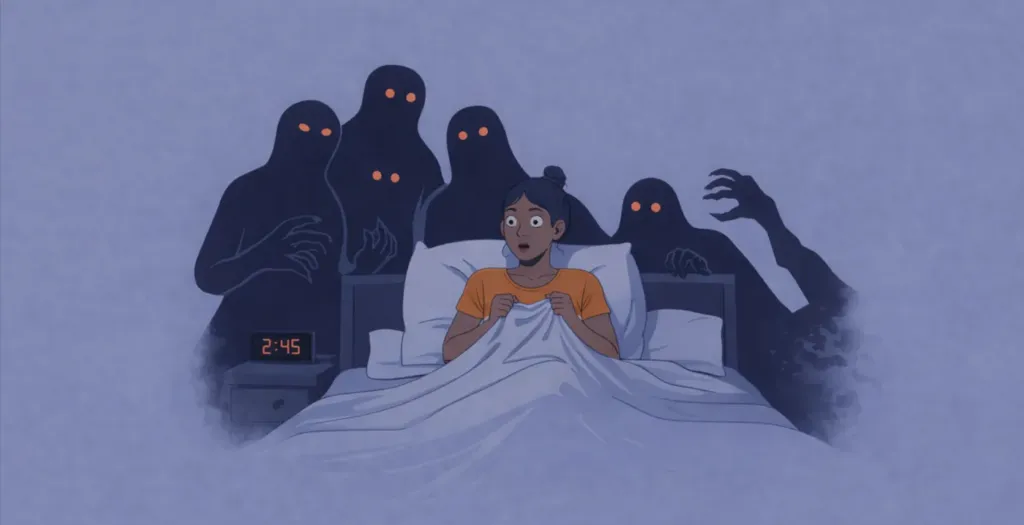
Sleep is one of the essential biological processes for physical and emotional recovery. However, in people who have experienced trauma, this mechanism can be significantly disrupted. Night terrors, recurring nightmares and sudden awakenings are not isolated episodes, but manifestations of a neurobiological system that keeps processing highly charged information, even while we rest.
These disturbances are closely linked to the functioning of two brain structures that are key to emotional regulation and memory consolidation: the amygdala and the hippocampus. Understanding how they interact during sleep, and how trauma alters their patterns of activity, helps explain why night-time can become a moment of vulnerability for so many people.
1. EXPLAINING THE CONCEPTS (PSYCHOEDUCATION)
To understand trauma and how it relates to disturbances of wakefulness and sleep, we need to understand the relationship between the hippocampus, the amygdala and the traumatic experience.
1. The hippocampus: the memory “library”
The hippocampus is a part of the brain responsible, among other things, for storing memories and placing them in time and space.
Think of it as the librarian who puts memories in order: what happened, when and where.
When a person has an ordinary experience, the hippocampus takes in this information, processes it and stores it in an orderly way.
But if the experience is very intense or traumatic, the hippocampus can become “overloaded” by the level of stress and fails to store the memory properly. That is why traumatic memories tend to be fragmented or extremely vivid, as if they did not belong to the past but were happening all over again.
2. The amygdala: the emotional “alarm”
The amygdala is the part of the brain that acts like an alarm that detects danger.
Its job is to trigger the appropriate emotional and physiological responses to threats: speeding up the heart, releasing adrenaline, preparing the body to flee or fight, and so on.
In traumatic situations, the amygdala becomes hyperactive and is “trained” to react to anything that is reminiscent of the traumatic experience, even when there is no longer any real danger, only a memory. In other words, with trauma, the alarm stays permanently switched on.
3. When the alarm and memory fall out of sync
In trauma, the brain experiences an imbalance between the amygdala and the hippocampus:
• The amygdala records the intense emotion (fear, terror, helplessness).
• The hippocampus fails to file the memory properly.
The result: the traumatic memory is not felt as something in the past, but is relived in the present (which is why, in PTSD – post-traumatic stress disorder – people experience flashbacks, nightmares or disproportionate reactions).
2. WHAT HAPPENS DURING A CRISIS?
The brain works on different “levels”:
-
Rational brain (neocortex) → Makes decisions, analyses, plans.
-
Emotional brain (limbic system) → Manages emotions and memories (amygdala, hippocampus…).
-
When the brain perceives an intense or prolonged threat:
-
The amygdala (the emotional alarm) takes control.
-
The hippocampus “freezes” (it cannot put the experience in order).
-
And the prefrontal cortex – the rational part – temporarily disconnects.
-
-
Instinctive brain (brainstem) → Regulates survival, that is, breathing, reflexes and the fight-or-flight mechanisms.
Under normal conditions, these levels work together: you feel an emotion, recognise it and decide how to act. When the limbic system is activated, the person loses these abilities and may feel confused, disoriented or even unreal.
When the emergency system never rests
In trauma, especially if the experience that caused it was intense or repeated, this alarm system stays switched on even after the danger has passed.
That is when symptoms such as these can appear:
-
Flashbacks or intrusive memories: the amygdala fires as if the danger were still present.
-
Depersonalisation or confusion: the hippocampus cannot place the memory in the past.
-
Intense emotional reactions with no apparent cause: the rational cortex tries to make sense of something it cannot control.
All of this creates a dissociation between thought and emotion.
“I know I’m safe, but my body reacts as if I weren’t.”
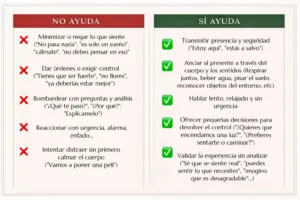
6. WHAT TO DO DURING A CRISIS?
First, it is important to be able to regulate the body (turn down the alarm – amygdala). Then we can put the mind in order and bring it back to the present moment (separating what is memory from what is present – hippocampus).
An overactive amygdala produces:
• Intense fear, being easily startled and hypervigilance.
• Nightmares, anxiety or impulsive reactions.
• Difficulty “thinking clearly”.
Calming the amygdala does not mean “convincing it that there is no danger”, but helping it feel physical and emotional safety. Only then does its activity decrease.
Strategies that calm the amygdala:
1. Safety and predictability
◦ Stable routines, surroundings without sudden shocks and a gentle tone of voice.
◦ Consistent behaviour from the people around them (the body perceives consistency as a sign that “there is no danger”).
2. Slow, deep breathing
3. Safe physical contact or deep pressure
◦ A firm hug, a weighted blanket, a gentle massage, etc.
◦ The body interprets: “if I can relax, there must be no threat”.
4. Rhythmic movement
◦ Walking, rocking, gentle dancing, etc.
◦ Repetitive movements help release adrenaline and stabilise the nervous system.
5. Connection and a compassionate gaze
◦ The amygdala calms down through co-regulation: another human being’s calm conveys safety.
◦ A warm look and a calm tone of voice are biological signals of peace.
Unblocking the hippocampus through grounding
Grounding means coming back down to earth – in other words, returning to the here and now.
When someone relives a trauma, feels anxious or is emotionally overwhelmed, their mind and body disconnect from the present:
• The brain believes it is reliving something from the past.
• The brain races ahead into the future with fear.
• The brain feels “floating” or “outside the body” (dissociation).
Grounding helps reconnect the body with the present moment.
When there is trauma or anxiety, the amygdala is activated (alarm mode) and the hippocampus disconnects (it doesn’t know what time it is in). Grounding helps the hippocampus reorient itself in the present, which allows us to:
• Calm the amygdala.
• Restore the connection with the rational cortex.
• Regain a sense of control and reality.
To put it less technically: it turns down the emotional heat and switches on the rational engine.
QUICK GROUNDING EXERCISES
Quick exercise (under 2 minutes):
“I’m in my bedroom. I can see the lamp, a plant, the blue painting… I’m touching the blanket, I can feel the cool fabric…
I can hear the fan…
I’m here, now.”
Quick exercise (under 2 minutes):
-
Look around you: name 5 things you can see.
-
Touch 4 things and describe their texture.
-
Listen for 3 sounds.
-
Notice 2 smells.
-
Notice 1 taste or bodily sensation.
-
Breathe slowly and say: “I’m here, right now. I’m safe.”
Different ways to practise grounding
Grounding refers to techniques that help a person come back to the present when they are highly activated, dissociated, anxious or having a flashback. There are three main ways of practising it: sensory, physical and cognitive.
Sensory grounding (the most immediate)
This involves using the senses to anchor the person in the here and now. Some ways of doing this:
• Look around and name 5 things you can see.
• Identify 4 things you can touch.
• Listen for 3 sounds.
• Notice 2 smells.
• Identify 1 taste or sensation in your mouth.
This helps the brain locate itself in real space and time, activating areas that signal that the danger has passed.
It is especially useful during crises, flashbacks or intense anxiety.
Physical grounding
Here the body and movement are used to return to the present. For example:
• Feel the weight of your body on the chair or the floor.
• Plant your feet firmly on the floor and notice the contact.
• Breathe deeply, noticing the air coming in and going out.
• Stretch, roll your shoulders or squeeze a ball between your hands.
It helps you come out of disconnection and regulate the nervous system.
It reminds the body that it is here and now, not in the memory or the threat.
Cognitive or mental grounding
This involves using mental orientation and simple thinking.
For example:
• Tell yourself:
“Today is Thursday, I’m at home and I’m safe.”
• Repeat your name, your age or where you are.
• Do a simple calculation (count from 1 to 10, count up in threes).
• Recite a song or poem you know well.
This helps reorganise the mind, cut through disorientation and strengthen your sense of the present and of safety.
A note from the author:
I know it isn’t always easy to sleep and that, even with techniques and strategies, some nights are still hard. But understanding what happens in our brain and how trauma affects our sleep can help us feel a little less lost.
It isn’t about applying the perfect method or finding instant solutions, but about acknowledging what we are going through and giving ourselves permission to look for ways to rest better. If you have read this far, remember: you are not alone, and every small step counts towards more peaceful nights.