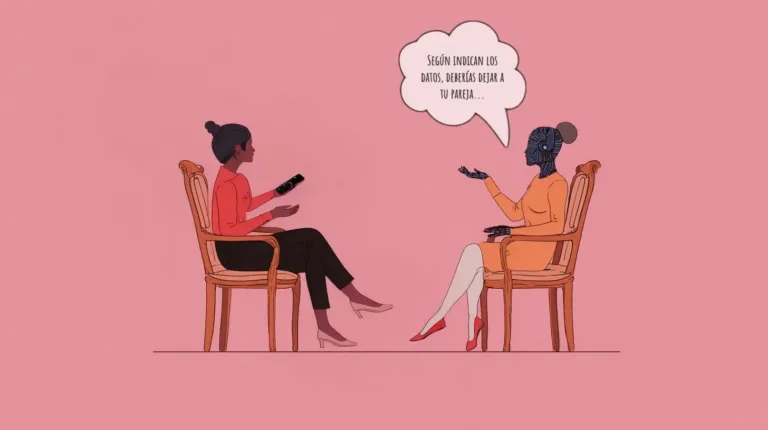



Let’s start with the obvious: communication is vital in any relationship. Now that we all agree on that, let’s go a little further into this business of communication, especially when it comes to communication between partners.
Communication in a relationship is like the Wi-Fi at home: when it works well, you don’t even notice how important it is, but when it fails (and it always fails on the day you need it most)… it’s frustrating, overwhelming and maddening all at once, isn’t it? Because, even though love is what holds the relationship together, without good communication even the strongest relationship starts to wobble.
It is common, because of the trust and bond we have built with our partner, to sometimes take it for granted that they should understand us without words, as if they had a built-in emotional radar. And not only that: we assume that, besides knowing what is going on with us, they should already know how to act. But the reality is that, however much we love each other and however special our connection, telepathic powers are, for the time being, still unreliable. Personal differences, fears, changes in circumstances and routine can turn into walls that are hard to climb if we don’t learn to communicate effectively. Each person interprets information through their own experience and emotions, which can lead to misunderstandings if things are not expressed clearly. It seems obvious, but skimping on communication increases – quite dangerously – the risk of misunderstanding each other. That is why improving communication is not just about talking more, but about talking better, with intention, empathy and openness.
It’s curious how often we talk a lot but say very little. In a conversation between partners, what matters is not just filling the silence with approximations, headlines and hints about what is going on, but clearly conveying what we really feel and need in each situation. It’s easy to fall into the trap of thinking that the other person will be able to interpret a half-finished message, that they should work out for themselves the meaning of something that requires common sense (which is often the least common sense of all, and the cause of more than one disaster) to decode. That is why putting what we want to express clearly into words is key to avoiding misunderstandings and needless frustration, and this takes responsibility, willingness, courage and patience to find the right words or channels of communication.
Listening is the other half of the equation, and it is often the part that slips away from us the most. When we think about communication, our mind easily focuses on the effort it takes to express what we feel, forgetting that even the best-expressed message is useless if it doesn’t reach the other person. Likewise, the most articulate message is pointless if it becomes a monologue, unable to adapt to or take in the messages of someone who also wants to be heard. It isn’t simply about hearing what the other person says while we mentally prepare our reply. It’s about being there, present in what they are saying, setting our own arguments aside for a moment, putting away distractions (and the phone), looking them in the eye and making them feel that we are truly there. Because few things create more distance than talking to someone who is there physically but absent emotionally. Have you ever wondered why we raise our voices in an argument, even when the other person is right next to us? Precisely because, when listening is not full and active, it creates such a great emotional distance that one feeling prevails over everything else: however loudly I express myself, the other person just isn’t hearing the message.
And, of course, we can’t forget those moments when emotions run high and conversations turn into verbal battles. It’s not that arguing is bad – quite the opposite. The problem is when, instead of trying to resolve a conflict, we focus on winning the argument, each from our own world of reasons and arguments. Words have power, and when they are used as weapons, they leave scars. Learning to express what we feel without attacking the other person is one of the keys to making sure disagreements don’t turn into cracks in the relationship. What you feel is valid, and so is what the other person feels. Each of us has our own truth, and when we try to impose ours as absolute, the other person may feel hurt, invalidated or attacked. This usually triggers one of two defensive reactions, confrontation or avoidance, and both can create even more distance in the relationship. In the end, what matters is not who is right, but how we manage to understand each other without turning communication into a gladiators’ arena.
Then there is silent communication, the kind that happens without us noticing. A sigh of frustration, an averted gaze, folded arms… all of this speaks. Have you ever felt your partner look at you in a certain way and, without the need for words, understood that they wanted you to hug them? These small gestures, these knowing looks, sometimes say more than any elaborate speech. Often, what we don’t say in words we express through gestures, and if we are not paying attention, we may be ignoring really important messages or even sending mixed messages between what we say and what we do. Being aware of our own body language and learning to read our partner’s helps us build a more honest and clearer channel of communication.
Deep down, it all comes down to something very simple: communication is connection. When we truly communicate, we grow closer, understand each other and strengthen our bond. It’s not about talking for the sake of talking, but about building bridges, about making both ourselves and the other person feel seen, heard and understood. And yes, it’s a constant learning process, because no communication (and no couple) is perfect. But with intention, responsibility, patience and a bit of a sense of humour, any relationship can get communication flowing (and flowing well).
If you found this article interesting, we recommend reading the following: